About Mohan

My photo
Bangalore, India
Mohan Krishnaraj has a proven track record of working with several Fortune 100 companies and optimizing customer interactions with the brand, offerings, and touch points by creating differentiated customer experience designs. As the Senior Director of User Experience at Aditi, he is responsible for leading enterprise-wide customer experience transformations and building a USP with the perfect blend of design and technology. His deep knowledge of the industry offers an ‘outside in’ approach that delivers great customer experience across sectors. Prior to joining Aditi, Mohan served as the Head of the User Experience Group at Wipro Technologies, where he has orchestrated multimillion dollar contracts, implemented innovative UX strategies and turned under-performing business units around.

Tuesday, April 1, 2014

A storytelling approach to creating more successful websites

Everyone loves a good story. A narrative filled with challenges and disappointments, failures and accomplishments inspire us, and help us learn. Storytelling is a great branding strategy, and it isn’t necessarily a one way dialogue, but it’s the one that allows the listener to participate as well. 
 
Choosing how to tell to tell a compelling story is as important as the story itself.
Often, a website with a powerful story is a great trick to sneak a message that you wish to emphasize into the visitors mind. When the visitor gets absorbed in the story, he drops off his intellectual guard and is emotionally moved. 
 
Leadingresearchers have proved that purchase decisions are often triggered by emotions than logic. Wouldn’t it be great to have a web design that can bring out the brand story with style and the strength to move your audience emotionally? Parallax websites have become increasingly popular lately for this very reason.

Here are my favorite five that uses parallax technique to create visually interesting and interactive experiences:

Life of Pi website incredibly demonstrates why the movie won four Oscars in Feb 2013. It brings out the winning moments to life with those stunning visuals. Scrolling through the site is absolutely entertaining!


 Cyclemon.com displays its products brilliantly with rich interactivity. The whole format creates curiosity and entices users to progress through the website. They have a rightly placed menu for those who wish to get to the product of interest directly, without scrolling through the entire page.


Atlassian has beautifully sold its product that aims to improve team collaboration with their Time Wasting at Work site. A truly fantastic story line that resonates with almost everyone. 


Lexus LS website captivates the viewer with stunning visuals and takes the user through the brand story with each scroll. While most parallax websites fail at optimizing the experience on mobile devices, this site has an amazing parallax when viewed on desktop and the images become static on mobile devices.  


 Iraq War website represents the timeline of major events that occurred during the war with simple and effective visuals. History that is often considered boring, has got its life with this website.


What new technique for digital storytelling fascinates you? Share it the comments below, would love to learn!

Thursday, February 13, 2014

User journeys demystified with experience mapping

In a business world keenly focused on ease-of-experience for the end customer, no other industry is a greater hotbed for experience mapping than retail.

With innovation at its highest pace, here’s a case in point of a large global retailer who succeeded in bringing life-likeshopping experience to subway stations. The virtual stores blend a mobile-based shopping experience into people’s everyday lives with smart phone’s simple QR code scan, and the product automatically lands in their online shopping cart enabling delivery at home on the same day. Following this campaign, online sales increased dramatically (Nov 2010 to Jan 2011). Through this campaign, 10,287 consumers visited the online Tesco (Homeplus) mall using smart phones. The number of new registered members rose by 76%, and online sales increased 130%. Currently, Homeplus has become No.1 in online market and is a very close 2nd offline.


Legendary examples like these that showcase the convergence of online and offline world have set new standards for the kind of independence and personalization that today’s users are getting comfortable with, thus raising the bar for cross-industry retail segment (banking, healthcare, automotive etc.).
Almost every other company is striving to create and manage a myriad of touch points that they want to add up to a differentiated customer experience. But, do customers actually care about all these massive efforts? Of course not, all they care is your ability to meet their needs across touch points and across competitive landscape making it easy and less effort intensive. And for any small/mid/large business it’s not an easy task to build these experiences. It requires deeper diagnosis of the user journey to contextualize.

Wondering how to accomplish this journey? Here are a few tips.

To begin with, let’s discover the value of experience mapping. 
An experience map is the key to demonstrate the interconnectedness of a cross channel experience between customers and businesses with emotions like cognitive dissonance, power of free, rewards and discounts, feel good factors etc.

It will allow you to identify opportunities and areas of improvement that will, in turn, propel strategic design direction keeping abreast of state-of-art, cross-channel customer acquisition, retention & conversion trends.

An experience map will enable a 360 degree view of the end customer’s patterns of activity that are associated with your service / product. Building a satisfied pattern will ensure the customer’s emotional stickiness extending your reach to his social and personal world.
This will be different for each geography based on cultures and user behavioral patterns.

How do we build experience maps?
Here’s a seven step approach to uncover the customer journeys; these when improved will unlock a more compelling and valuable experience.


User Research:
The research and discovery process is an essential investment to ensure that the experience map captures the full customer step by step mind mapping. Piecing together the big picture of how and why your customers are interacting with different channels, touch points, products and services is where your journey begins.
This step will serve as the backbone to the entire experience mapping process, hence make sure to uncover the truth to tell the story right. 

Customer Segmentation:
Once after the user research process is complete, as a conscious next step, consider profiling customers based on the similarities they share in terms of interactions and conversion patterns. This persona development coupled with heuristic evaluation & competitive assessment will help in getting a firmer understanding of both customer experience and the context around it. 

PET (Persuasive, Emotion and Trust) – Analysis:
PET is a methodology for making user experience more engaging, compelling and effective. This adds a layer of psychology to gently nudge customers towards the desired action.
Attempt aggressively to understand the motivational and emotional triggers for each of the personas defined above. While usability facilitates actions such as browse, search, consume, comprehend, interact, etc., PET encourages users to engage, connect, convert and return.


User Group – Touch point mapping:
Bring the data you collected to life with user scenario mapping. Chart out the information architecture that emphasizes the most important dimensions of customer experience.
Remember this whole process is not a sole adventure, bring the critical stakeholders on board to engage in discussions that experience mapping fosters and build a consensus. Define metrics to identify the transformation in user satisfaction this whole experience mapping process has brought.

Takeaways:
The moment a plan to map the customer journey evolves, the focus should primarily shift towards the identifying the key takeaways. This should essentially include strategic insights, recommendations and design principles. Every small observation on user behavior on different touch points will help redefine the whole paradigm of design.

Get started!
Experience mapping is not an easy task, it takes quite a bit of time and effort. When done well, you can gain a single customer view in a multi-channel world and identify the highs and lows people feel while interacting with your products or services.

For those of you sailing on your own mapping journey, let us know how it’s going in the comments below. Would love to learn all that it takes to delight customers!

Thursday, August 15, 2013

Gamification


The theory of Gamification stems from empathy

Duolingo is a free language learning website. It gamifies online learning by giving points, timed tests and level-ups to performers. With its gamified approach to language-learning, it’s proven to be one of the most popular education apps on the market.


So, what’s this new buzzword – Gamification?

Simply put, Gamification is the use of game-thinking and game mechanics in a non-game context.

For instance, a non e-commerce websites like Linked In has introduced the concept for profile completion. Nike has introduced Nike Fuel for miles run, distance covered and records broken. It’s a brilliant example for intersecting personal and community spaces through gamification.


Current trends have seen a great acquaintance to “Gamification”. In fact, a global research company Markets and Markets predicts the Gamification segment to be worth $5.5 billion by 2018, from the $421 million market it is today (Report). Gartner predicted that by 2014, 70% of the Global 2000 would have at least one ‘gamified’ application. Doing the math, that means 1400 large organizations over the next 36 months.

So let’s talk about a few paradigms that can make Gamification work. I would enlist these as Immersive experience, Micro & Macro focus, Instilling a sense of achievement, Registering progress in the user’s mind and clear Rewards and Recognitions.


In my experience, a few techniques, that have been applied on Gamification projects with tangible results, include :
  • Achievements / badges
  • Levels
  • Leaderboards
  • Progress bars
  • Activity feeds
  • Avatars
  • Real-time feedback
  • Virtual currency
  • Gifting
  • Challenges and quests
  • Trophy case
  • Embedding small mini games within other activities
While gamification can have very legitimate business application, I feel good design and user experience will be key to making it work. ‘Gamification as a panacea’ is a must-avoid trap. Consumers also can see through any forced-on game mechanics.
 

Thursday, July 25, 2013

Which way to go - Adaptive/Responsive?

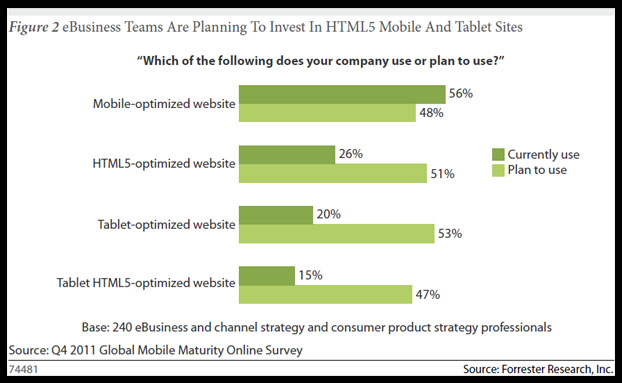
In the 'post-PC world', where 30%-50% of website traffic comes from mobile devices, how must organizations deal with this change in user behavior? eBusiness teams are planning big time investments in this space, as the below chart from Forrester confirms :


Responsive Design / Adaptive Design are two buzzwords making the rounds in the digital space / user experience space while defining omni-channel experiences. To the layman, they probably sound like two interchangeable labels for the same technology. They optimize web content to fit a variety of devices. But the differences between the two often set the stage for the responsive vs adaptive dilemma faced by enterprises who offer their services on the web.

Though there is no grounded methodology or a successful formula, here are a few thoughts on the process behind these:


Responsive Design is client-side; Adaptive design is server-side. The difference between the 2 adaptation for development with pros & cons are as below:

As for all technology decisions faced by enterprises, the solution to the responsive vs adaptive dilemma depends on their mobile web strategy and the outcomes they expect. If a business is looking to upgrade their existing web services to a mobile-friendly customer base, responsive design might serve the purpose. But if a business is focused on a mobile-first user experience, the key to the future lies in adaptive design.
Content is still a challenge and important to be focused on:

While companies make decisions on either methods of implementation, the end customer’s expectation is still not easy to comprehend. The user expects content to be maintained across devices with no expectation on his memory load To give an e.g. – a typical, young user trying to register on a portal has very little patience with filling up lengthy forms for personal details. As per his expectation, he can only fill in his leisure time and with available devices around him; the onus of getting this information from him is on the organization.

This is possible only with a seamless content state across devices;
this is being predominantly adopted off late as per the below
Forrester report.